Your Screen Has Nothing to Say
Digital signage is stuck in a passive, broadcast-era model, and only by embracing interactivity and measurable engagement can organizations transform screens into meaningful, data-driven experiences that audiences actually care about.
This article is the first in a series by Intuiface CEO Mathieu Yerle. Subscribe to his Substack, Screen Heresy, for early access to his latest posts.
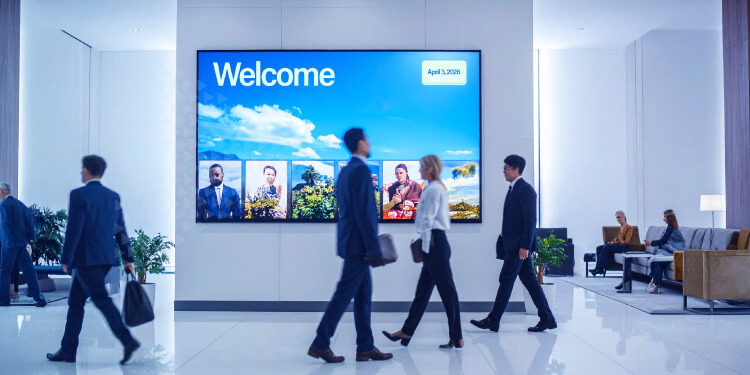
There's a screen in the lobby of nearly every hotel I walk into. It shows the weather. A welcome message. Maybe a rotating set of pool images.
Nobody looks at it.
Not because the screen is bad. Not because the content is ugly. But because it has nothing to say to me. It's talking to a wall. And everyone in that lobby knows it.
This is the state of most digital signage in 2026. Billions of dollars in hardware. Millions of screens. And the dominant strategy is still: put something on a screen, schedule it, hope someone notices.
Hope is not a strategy. And passive broadcast is no longer enough.
The "linear TV" problem
As I shared in my Year in Review for invidis earlier this year, I came to Intuiface because I saw this industry standing at the same precipice that media and entertainment faced a decade ago. That conviction has only deepened. Let me explain why.
I spent over a decade in broadcast and media technology. I watched - from the inside - as the entertainment industry went through its most disruptive shift in half a century.
For decades, TV worked on a simple model: program a schedule, push it out, measure reach. Audiences had no choice but to accept what was given to them. Then streaming arrived and changed the contract entirely. People didn't just want to watch. They wanted to choose. They wanted control. And the companies that understood that shift early became the next generation of leaders. The ones that didn't are still struggling.
Digital signage is now at exactly that inflection point.
The screens are everywhere. The infrastructure is built. But the model - schedule content, push it out, measure "proof of play" - is a broadcast-era model running on streaming-era expectations.
Today's audiences are digitally native. They touch, they swipe, they query. They navigate their own path in every other part of their digital life. When they walk into a showroom, a museum, an event, a hotel - they don't suddenly become passive. They're still looking for agency. And when a screen doesn't offer it, they ignore it.
Proof of play is not proof of value
Here's what keeps me up at night: most of the digital signage industry has never truly had to prove that its content works.
The standard metric has been "proof of play." Did the content run? Yes. Did it display at the right time on the right screen? Yes.
Did anyone care? Unknown.
This is a measurement system designed for the operator, not the business. It tells you the machine is working. It says nothing about whether the communication is working.
Compare that to every other channel a CMO manages. In digital marketing, you measure clicks, conversions, engagement, dwell time, path analysis. In e-commerce, every interaction is tracked, optimized, and iterated. But in physical spaces - where brands spend enormous budgets on environments, events, and experiences - the measurement model is still essentially: "the content played."
Interactivity changes this equation entirely.
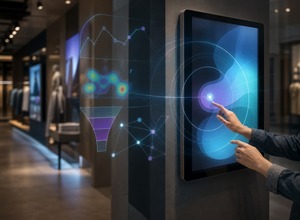
When content is interactive - when someone navigates a catalog, explores a story, asks a question - every one of those interactions becomes data. Real behavioral data. Not proof of play. Proof of engagement.
That's not a technical upgrade. That's a category shift.
The gap is not technology - it's imagination
The technology for interactive experiences in physical spaces is already here. Touchscreens are commodity hardware. Sensors are cheap. Mobile integration is mature. AI is making content creation faster than ever.
The barrier is not the technology. It's the assumption.
Most organizations still think of screens in physical spaces as broadcast channels. They hire the same agencies, use the same CMS platforms, and measure the same metrics they've used for fifteen years. They're solving a 2026 problem with 2010 thinking.
The organizations that are breaking out of this pattern - and I see them every week in museums, corporate innovation centers, retail flagships, and trade show floors - aren't just putting better content on screens. They're rethinking the relationship between the space and the person standing in it. They're turning one-way broadcasts into two-way conversations. And they're getting data they never had before.
Beyond the Screen
This is the first post in a series I'm calling Screen Heresy.
Every two weeks, I'll be writing about what's actually happening at the intersection of physical spaces, digital communication, and audience behavior. Not product updates - we have channels for that. Something different.
I want to explore why some organizations are getting extraordinary results from their environments while most are still running silent loops. I want to share real examples, challenge industry assumptions, and make the case - with evidence - that we are in the early stages of a fundamental shift.
The shift from screens that broadcast to spaces that interact.
Because the real story was never about the screen. It's about what happens when someone stands in front of it - and the screen actually has something to say back.
If you're a brand leader, an experience designer, a museum director, a retail strategist, or anyone who believes physical spaces should do more than look good - follow along.




.jpg)
