Three Seconds in Front of a Picasso
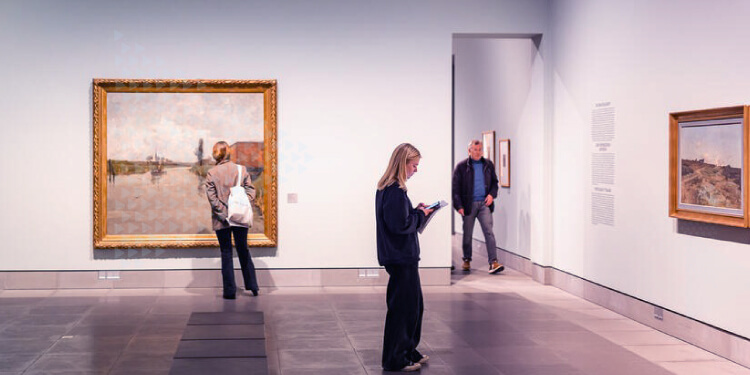
Museums hold some of the world's most extraordinary stories, yet visitors often spend just a few seconds engaging with each exhibit. By combining remarkable content with thoughtful interactivity, museums can transform fleeting glances into meaningful moments of exploration and discovery.
This article is the second in a series by Intuiface CEO Mathieu Yerle. Subscribe to his Substack, Screen Heresy, for early access to his latest posts.
In my first post, I argued that most screens have nothing to say. That the digital signage industry is stuck in a broadcast model - schedule content, push it out, hope someone notices.
I heard a few push-backs. The argument was essentially: “The problem isn’t the model. It’s the content. If the content were better, people would pay attention.”
I want to take that argument seriously because there’s an entire industry that disproves it.
The best content on earth, ignored
Museums have the best content on earth. Original Rembrandts. Dinosaur skeletons. Artifacts from civilizations that disappeared three thousand years ago. No one is going to open their phone and find better content than what’s hanging on the wall in front of them.
And yet.
Most visitors drift. They glance. They move on. They walk past content that someone spent months researching, conserving, and curating - and they barely register it. Entire sections get skipped. Rooms full of masterpieces get a passing look on the way to the gift shop.
The Cleveland Museum of Art1 measured this directly. Before they rethought their approach, the average time visitors spent looking at an artwork was two to three seconds.
Two to three seconds. In front of a Picasso.
This is not a content quality problem. This is an engagement model problem. And it’s the same problem playing out in hotel lobbies, corporate showrooms, retail stores, and trade show floors. Just more visible in museums because the gap between the quality of the content and the depth of the engagement is so absurdly wide.
The placard problem
Walk into most museums, and here’s what you’ll see next to the exhibits: a small white placard. Title. Artist. Date. Maybe a paragraph of context in a font size that requires you to lean in uncomfortably close.
This is the museum equivalent of proof of play. The information is technically there. It technically ran. Did anyone engage with it? Nobody knows.
The placard hasn’t fundamentally changed in a century. And the visitors have changed completely. They’ve spent the last decade navigating Netflix, swiping Instagram, tapping through interactive apps. They’re wired for agency. They expect to choose what to explore and how deep to go. Then they walk into a gallery, and the communication model is: here’s a paragraph, take it or leave it.
Most of them leave it.
What changes when you add interaction
Here’s where it gets interesting. The Cleveland Museum of Art decided to find out what happens when you give visitors something to do instead of something to read. They built a space called ArtLens Gallery - a 40-foot interactive wall displaying every work currently on view, gesture-based games that let visitors physically engage with masterpieces, and an app that turned the whole museum into a self-directed exploration.
Then they did something most museums never do: they actually measured it.
An independent evaluation funded by the National Endowment for the Arts2 found that visitors who spent just five to ten minutes in the interactive gallery stayed 30 minutes to an hour longer in the museum overall. 76% said the experience enhanced their visit. 74% said it encouraged them to look more closely at the art. And millennials - the demographic every institution is desperate to reach - were 15% more likely to visit the digital gallery than older adults.
The CMA’s Chief Digital Officer put it bluntly:
“We’re not competing with other museums. We’re competing with Netflix.”
She’s right. And that line applies to every organization with a physical space and a screen in it.
Give people a role, not a placard
The Cooper Hewitt Smithsonian Design Museum3 in New York took a different approach to the same problem. After a $91 million renovation, they gave every visitor a simple tool: a digital pen. Tap the pen against any exhibit tag in the museum, and it saves that object to your personal online collection. Bring it to one of the museum’s touchscreen tables to explore what you’ve collected, manipulate designs, or sketch your own wallpaper and watch it projected floor-to-ceiling on the walls around you. Return the pen when you leave, and everything you collected is waiting for you on a personalized website.
The pen didn’t replace the exhibits. It gave visitors a role in the experience. They weren’t just looking at design - they were doing design. Collecting, choosing, creating. And every tap generated data that the museum could use to understand what visitors cared about.
The insight here is subtle but powerful. The pen didn’t make the content better. The content was already world-class. What the pen did was change the relationship between the visitor and the content. It shifted the visitor from observer to participant. And that shift - from passive consumption to active engagement - is what unlocked attention, dwell time, and data.
Why this matters beyond museums
I’m spending an entire post on museums for a reason. Museums are the clearest evidence for the argument I started building in my previous post.
If the best content in the world - original art, ancient artifacts, irreplaceable historical objects - still gets ignored when it’s presented passively, then no organization should assume their content is compelling enough to survive the placard treatment.
Your corporate lobby screen? Your trade show booth? Your retail product display? If a Picasso can’t hold someone’s attention for more than three seconds behind glass with a static label, what chance does your quarterly messaging have on a loop?
The answer is not better content. The answer is a different model. One where the audience has agency. Where the communication is a conversation, not a broadcast. And where every interaction generates data that makes the next one better.
The Cleveland Museum of Art proved it - visitors who spent five minutes in their interactive gallery stayed up to an hour longer in the museum overall. Cooper Hewitt proved it - 94% of visitors chose to pick up the interactive pen. This isn’t theory. It’s measured. By independent researchers, with public funding, in two of the most respected museums in the country.
Museums are figuring this out. Slowly, but they’re figuring it out. The organizations that apply the same thinking to every physical space they operate - the showroom, the lobby, the store, the event - will be the ones that actually get the attention, engagement, and measurable outcomes they’ve been hoping for.
Hope, as I said last time, is not a strategy.
But giving your audience a role in the experience? That’s a start.




.jpg)
